Key Takeaways
- 1Onchain DEX routing is the process of finding the best executable path across pools, venues, and hops on the same network.
- 2The route with the best headline quote is not always the route with the best total outcome after gas and price impact.
- 3Route quality changes with order size, liquidity depth, congestion, and how quickly the market moves between quote and execution.
When people say they want the “best rate,” what they usually imagine is simple: one market, one price, one obvious trade.
Onchain reality is messier than that.
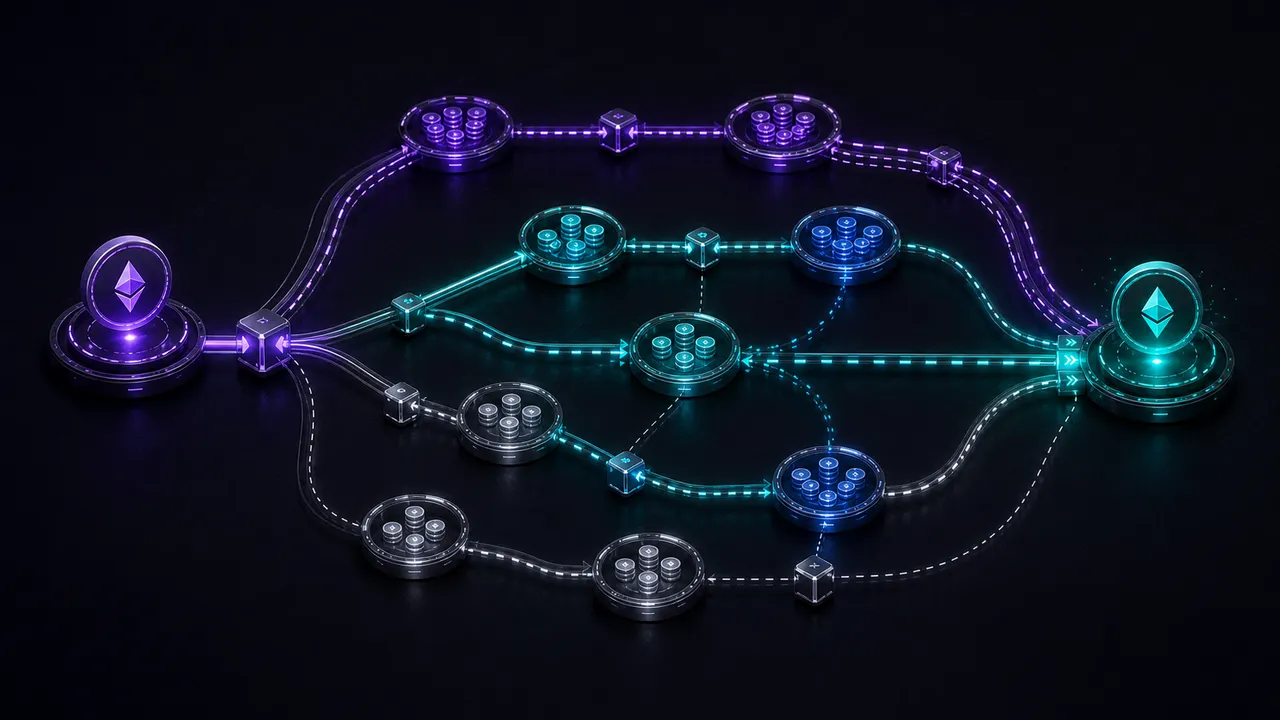
Liquidity is scattered across pools, fee tiers, protocols, chains, and execution models. Even for a familiar pair, there may be several ways to get from token A to token B, and they do not all produce the same result once gas, depth, and price impact enter the picture.
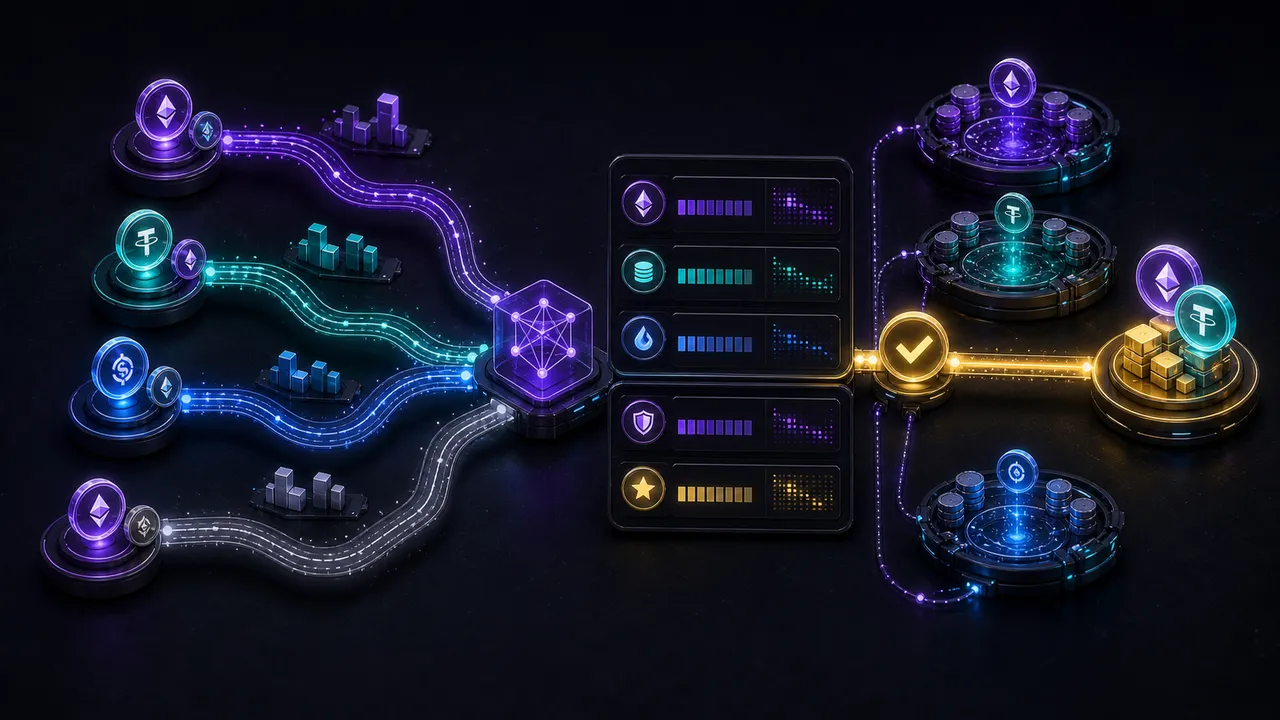
That is where onchain DEX routing comes in. Routing is the process of deciding how a trade should travel through available liquidity in order to achieve the best practical outcome.
Sometimes that means using one direct pool. Sometimes it means splitting the order. Sometimes it means hopping through an intermediate asset. And sometimes the best-looking headline quote is not the best route after costs are counted.
At a glance: Routing is not an extra detail added after the swap. It is the mechanism that decides whether the swap is efficient, expensive, fragile, or surprisingly good.
Why routing exists in the first place
In traditional markets, people sometimes assume that “the market” is a single place. In DeFi, it usually is not.
For one token pair, liquidity can be spread across:
- multiple DEXs
- multiple pool fee tiers
- multiple pool designs
- multiple versions of the same protocol
- multiple chains or rollups
- multiple route types with different execution mechanics
That fragmentation is both a strength and a headache.
It is a strength because more liquidity sources can create more competition and better execution opportunities. It is a headache because no human should be expected to inspect them manually every time they hit Swap.
A router exists to solve that problem.
What a router is really trying to optimize
The most common mistake is to think a router only chases the highest nominal output.
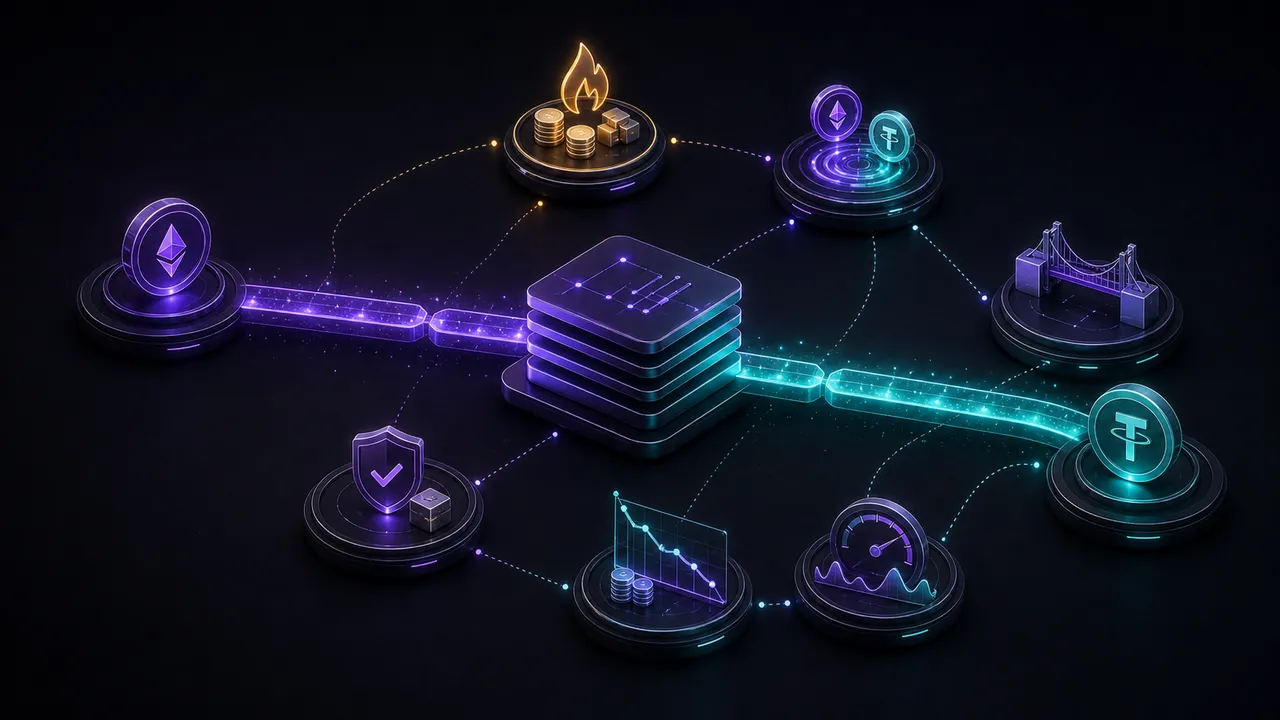
A good router is usually optimizing something broader:
- expected output
- price impact
- gas cost
- slippage risk
- route reliability
- execution speed
- available liquidity at that size
- the chance that the route still makes sense by the time it settles
That last point matters. A route is not chosen in a vacuum. It is chosen in a live market.
A path that looks perfect on paper can become expensive or unstable once gas, volatility, or thin liquidity enter the room.
The basic routing patterns
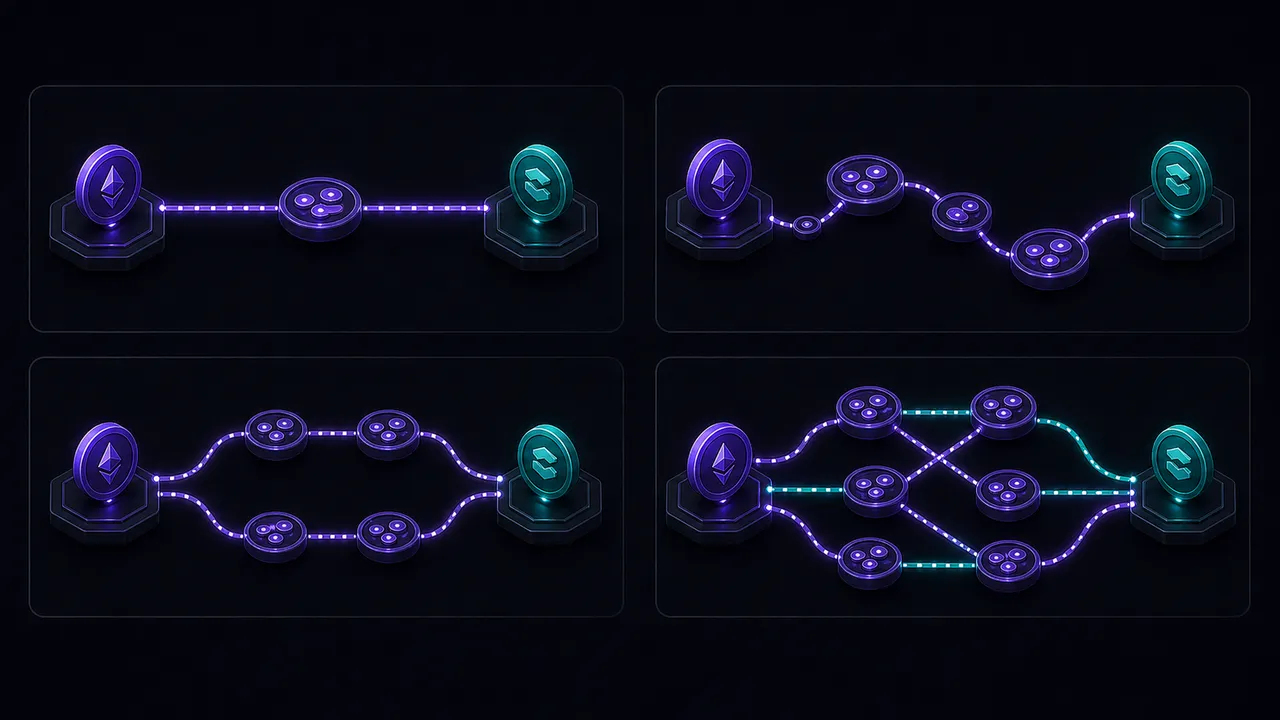
Most onchain routing falls into a few familiar patterns.
1. Direct routing
This is the cleanest version. You swap token A for token B through a single pool or venue.
It is often the best option when the pair is liquid and the pool is deep enough to absorb your order without much price impact.
Example. USDC to ETH through one highly liquid pool.
Direct routes are easy to explain and usually easy to inspect. But simplicity is not the same as superiority.
2. Multi-hop routing
Sometimes there is no great direct pool, or the direct pool is not the cheapest path.
In that case, the router may move through an intermediate asset.
Example. Token A -> USDC -> ETH
That is called a multi-hop route. It can unlock deeper liquidity or better pricing, though it also adds complexity and sometimes more gas cost.
3. Split routing
A larger order may be too expensive if forced through a single pool. The router can instead split it across multiple pools or venues.
Example. 60% of the order through Pool X, 40% through Pool Y
This is especially useful when liquidity is fragmented and no single venue has enough depth at a good price.
4. Aggregated routing
Some systems source liquidity from multiple protocols or execution layers rather than one DEX alone. At that point the router is acting more like a route engine than a simple pool selector.
That is increasingly important as DeFi becomes more modular.
Why the cheapest-looking route is not always cheapest
This is one of the hardest ideas for newer traders to internalize.
A route that offers the best raw quote may still lose once you include:
- gas
- approval cost
- bridge cost
- higher failure probability
- greater price impact
- lower liquidity depth
- slower or more fragile execution
In other words, the route with the highest advertised output is not automatically the route with the best actual outcome.
That is why sophisticated interfaces compare routes on a net basis.
A concrete example
Imagine you want to swap a mid-sized position from one token into ETH.
You might have three possible routes:
| Route | Headline price | Gas cost | Liquidity depth | Expected reliability |
|---|---|---|---|---|
| Direct pool | Good | Low | Medium | High |
| Multi-hop through USDC | Slightly better | Medium | High | High |
| Split across two venues | Best headline quote | Higher | High | Medium |
Which one is best?
The answer depends on your size, tolerance for complexity, and live market conditions. If the split route saves a tiny amount on quote but adds a lot of gas and fragility, it may not be worth it. If the direct route is too shallow, the multi-hop route could win even if it looks more complicated.
That is why the best route is a calculation, not a slogan.
What makes routing harder onchain than it first appears
Routing would be easy if every pool were equally deep and every transaction cost the same. They do not.
Here is what makes it tricky:
Liquidity depth changes with size. A small trade and a large trade can have completely different best routes.
Gas changes in real time. A route that is efficient at one moment can become unattractive when gas rises.
Some liquidity is cheap but thin. A pool may look appealing until your size pushes too far into it.
Multi-hop routes add trade-offs. They can improve price but worsen gas.
Markets move between quote and execution. Routing is always happening under live conditions, not in a frozen spreadsheet.
This is one reason modern DeFi routing feels closer to logistics than many users expect. The question is not simply “where is the price.” It is “what path gets me there best right now.”
How onchain DEX routing fits into MindSwap
MindSwap’s advantage is not that it must explain every pool on earth. It is that it can explain why a route class was chosen without forcing the user to reverse-engineer the whole market.
For an onchain DEX route, the product should make a few things obvious:
- this is an onchain liquidity route, not a private or gasless execution path
- the route may use direct, multi-hop, or split execution
- the result reflects both pool pricing and network cost
- the best route may change with size and market conditions
- the displayed route is chosen because it outperformed available alternatives on the dimensions that matter
That last line is especially important. Users rarely need every microscopic detail. They do need confidence that the path was chosen deliberately.
When an onchain DEX route is usually the right call
An onchain route is often strongest when:
The pair is liquid. Deep pools make direct or lightly optimized routes attractive.
The trade size is moderate. A modest order can often execute cleanly without exotic routing.
The user values transparency. Some traders prefer a route they can inspect directly onchain.
A special route type is unavailable. If private, gasless, or cross-chain execution does not apply, onchain DEX routing may be the most efficient path.
When onchain routing may be less ideal
It can be weaker when:
- the order is very large relative to pool depth
- public mempool exposure is a serious concern
- gas is unusually expensive
- the asset is spread across fragmented or low-quality liquidity
- a different execution model offers materially better reliability
Again, the right way to frame this is not “onchain bad, special route good.” It is “different route types solve different problems.”
The language that makes routing easier to understand
The most helpful onchain routing copy is usually not technical theater. It is plain language.
Good examples of route messaging include:
- “Best onchain DEX path found across available liquidity”
- “This trade may use multiple pools to reduce price impact”
- “Route selected based on expected output, gas, and available depth”
- “Large trades may be split across venues”
That kind of phrasing does more for trust than dumping ten contract addresses into the interface.
Final thought
Routing is the hidden craft of swapping.
Users see a quote. Routers see a maze: pool depth, gas, fragmentation, hops, spreads, and the risk that the market shifts before settlement. A good route engine turns that maze into something that feels simple on the surface without pretending the complexity is not there.
For MindSwap, that is a real editorial opportunity. Explain onchain DEX routing clearly, keep the promises factual, and show that the route is chosen to improve the actual trade, not just the screenshot version of it.
FAQ
What is onchain DEX routing?
It is the process of selecting the best available path through onchain liquidity sources to execute a swap.
Why would a router use more than one pool?
Because splitting or hopping through multiple pools can reduce price impact or improve the final outcome.
Is a direct route always best?
No. A direct route is often simpler, but a multi-hop or split route can outperform it depending on liquidity and gas.
Does routing affect fees?
Yes. Routing changes the total economics of a trade by affecting gas, price impact, and sometimes the number of steps involved.
How does this differ from a private or gasless route?
Onchain DEX routing focuses on where liquidity is sourced onchain. Private and gasless routes change other parts of the execution model.
Related reading
To compare live route types in one place, return to the MindSwap homepage.
Pro Tip
Look past the headline price
Use MindSwap to compare onchain DEX routes with other route families when you want the best practical outcome, not just the prettiest quote.
- •Check gas and price impact together
- •Review whether the route is multi-hop
- •Refresh before signing if the market is moving