
Key Takeaways
- 1Gasless routing appears only when the specific pair, route, and provider conditions line up at quote time.
- 2Order size, chain support, token support, and provider economics all influence whether a route can be sponsored.
- 3If gasless is unavailable, the honest alternatives are to fund the wallet, simplify the path, try another pair, or wait and refresh.
One of the most confusing moments in a modern swap interface is seeing a gasless route on one trade and then watching it disappear on the next.
Same wallet. Same session. Sometimes even the same chain.
So what changed?
The answer is that gasless routing is not a universal switch. It is a conditional route type. It appears only when the trade, the chain, the token pair, and the execution environment all line up in a way that makes gasless execution possible and sensible.
That is why the right question is not “Does this platform support gasless?” in the abstract. The better question is:
For this trade, under these conditions, is a gasless route currently viable?
Once you frame it that way, the feature becomes much easier to understand.
The basic rule
Gasless routing is available when the route engine can find a path where:
- the user can authorize the trade without sending a standard gas-paying transaction from the wallet
- a third party or route infrastructure can execute the trade onchain
- the trade economics still make sense after execution cost is accounted for
- the chain, token, and route mechanics support that flow
That is the whole thing.
If one of those conditions breaks, the gasless route may disappear.

Why gasless is not universal
Gasless routing sounds simple from the user side. Under the hood, it depends on a lot of moving parts.
That includes:
- chain support
- route infrastructure
- token compatibility
- approval method
- liquidity access
- execution partners
- order size
- current market conditions
A platform can support gasless routing in general without being able to offer it for every token on every chain at every moment.
That is not a flaw. It is the reality of route-based execution.
The most common conditions that make a gasless route available
1. The chain supports the route design
Some chains are easier to support for gasless execution than others. Infrastructure, settlement patterns, and the surrounding execution ecosystem all matter.
If a platform has not enabled or integrated gasless infrastructure on a given chain, the route simply will not appear there.
2. The token pair is compatible
Gasless routing is usually more realistic for token pairs with sufficient liquidity and route support.
Highly liquid, commonly traded pairs are often easier to support. Long-tail assets are more likely to fall back to standard execution.
3. The approval model works
In many gasless systems, the user authorizes a swap through signatures or compatible approval flows rather than a conventional gas-paid transaction.
If the token or route does not support the needed authorization mechanics cleanly, gasless availability may be limited or absent.
4. The execution economics make sense
Someone still has to execute the trade.
If the route engine cannot find an economically viable way to cover gas and settle the order competitively, the gasless path may not be offered. This can be especially relevant for smaller orders, illiquid assets, or routes with thin margins.
5. A filler, solver, or relayer path is available
Gasless execution often depends on third-party infrastructure. If that execution path is unavailable, degraded, or unattractive under current conditions, the route may drop out.
6. The route is still the best practical option
Even when a gasless path exists in theory, it may not be surfaced if another route delivers a better overall result for the user.
That is an important point. Availability is not the same as selection.
Why gasless routing may appear and disappear
This is where user frustration usually begins.
A gasless route can vanish because:
- the market moved
- gas changed
- liquidity shifted
- the route requoted
- the order size changed
- the asset pair changed
- the destination chain changed
- a supporting executor stopped being competitive
- a different route became better
From the platform’s point of view, this is just live routing. From the user’s point of view, it can feel inconsistent unless the interface explains it well.
How order size affects gasless availability
Order size is more important than many users realize.
Very small orders. They may be too small to make the gasless path worthwhile from an execution standpoint.
Medium orders. These can often be the sweet spot where the route is viable and competitive.
Large orders. They may still qualify, but liquidity and execution constraints become more important.
That means a route can be gasless at one size and non-gasless at another, even for the same token pair.
How route type affects gasless availability
Gasless routing also interacts with other route categories.
Standard onchain DEX routes. These often require the user to pay gas directly, unless the platform has a gasless execution layer available for that path.
Private routes. Some private routes can overlap with gasless behavior, but not all private routes are gasless.
Cross-chain routes. Cross-chain execution can sometimes be compatible with gasless handling, but the combined requirements are more complex. Availability is therefore more conditional.
This is one reason route labels matter so much. Users should never have to guess whether “private,” “gasless,” and “cross-chain” are describing the same property. They are not.
Signs that a gasless route is available
A good interface usually makes gasless availability easy to recognize.
Common signals include:
- a route label that explicitly says “gasless”
- copy that says the user does not need the native gas token for this trade
- a signature-based flow rather than a standard wallet submission flow
- messaging that the total output already reflects route execution costs
- route details that explain why the gasless path was chosen
The key is specificity. Users trust route labels more when they come with one sentence of explanation.
Signs that gasless routing is not available
These are the clues that the user is looking at a standard path instead:
- the wallet must submit a normal transaction
- the interface warns that the user needs the native gas token
- the route lost its gasless label after a refresh
- an approval transaction is required in the standard way
- the product explicitly says the current route is onchain only
Again, the more route-aware the platform is, the easier it becomes to make these differences legible.
What to do when gasless routing is unavailable
Users usually need a simple fallback plan.
Option 1: Fund the wallet with a small amount of native gas. This is the most obvious backup path.
Option 2: Reduce complexity. A simpler route or smaller trade may change availability, though users should not force this just to chase the label.
Option 3: Try a different asset pair or path. Sometimes the final destination can be reached through a more supported combination.
Option 4: Wait and refresh. In live markets, route availability can return as conditions change.
Option 5: Compare the non-gasless route honestly. Sometimes the standard route is still the better overall trade.
The point is not to make gasless the goal. The goal is a good result.
How MindSwap should explain gasless availability
MindSwap can handle this elegantly with a very small amount of precise copy.
A helpful gasless explanation would answer:
- Is gasless available right now?
- Why is it available?
- Why did it disappear, if it did?
- What changes if the user proceeds with the non-gasless route?
Examples of helpful product language:
- “Gasless route available for this pair and size.”
- “No native gas token required for this route.”
- “Route refreshed: gasless execution no longer available under current conditions.”
- “Standard onchain route shown instead; native gas token required.”
That level of clarity does a lot of work.
A useful mindset for users
The simplest way to think about gasless routing is this:
Gasless is not a permanent product promise. It is a route condition.
That mindset makes a lot of other things clearer:
- why it is not always available
- why it can change after a requote
- why it may apply to one asset pair but not another
- why a route engine should compare it against non-gasless options rather than force it every time
Once users understand that, the feature feels much less mysterious.
Final thought
Gasless routing is one of the best examples of how modern swap products are becoming more contextual.
It is not “on” or “off.” It is available when the chain, tokens, route mechanics, and economics support it. When those pieces align, gasless execution can remove a major point of friction. When they do not, the platform should say so plainly and help the user move to the next best route.
That is the standard MindSwap should aim for: not hype, but legible route logic.
FAQ
Why is gasless routing available for one trade and not another?
Because gasless availability depends on chain support, token pair, order size, execution infrastructure, and current route conditions.
Does a gasless route mean there are no network costs?
No. It means the user usually does not need to pay the native gas token directly from the wallet at submission time.
Can a requote remove a gasless route?
Yes. If market or route conditions change, the platform may refresh the quote and surface a different route.
Are all private routes gasless?
No. Private routing and gasless execution are different route properties, even though they can overlap in some cases.
Should I wait for a gasless route to come back?
Sometimes it makes sense to refresh and compare again. Other times the best choice is simply the strongest available non-gasless route.
Related reading
To check which route types are available right now, return to the MindSwap homepage.
Pro Tip
Treat gasless as live eligibility, not a promise
The swap surface shows whether the route is available now. The blog explains why that answer can change five minutes later.
- •Compare route options instead of waiting blindly
- •Review whether order size changes eligibility
- •Keep a fallback plan if the sponsored route disappears
Related Posts
Blog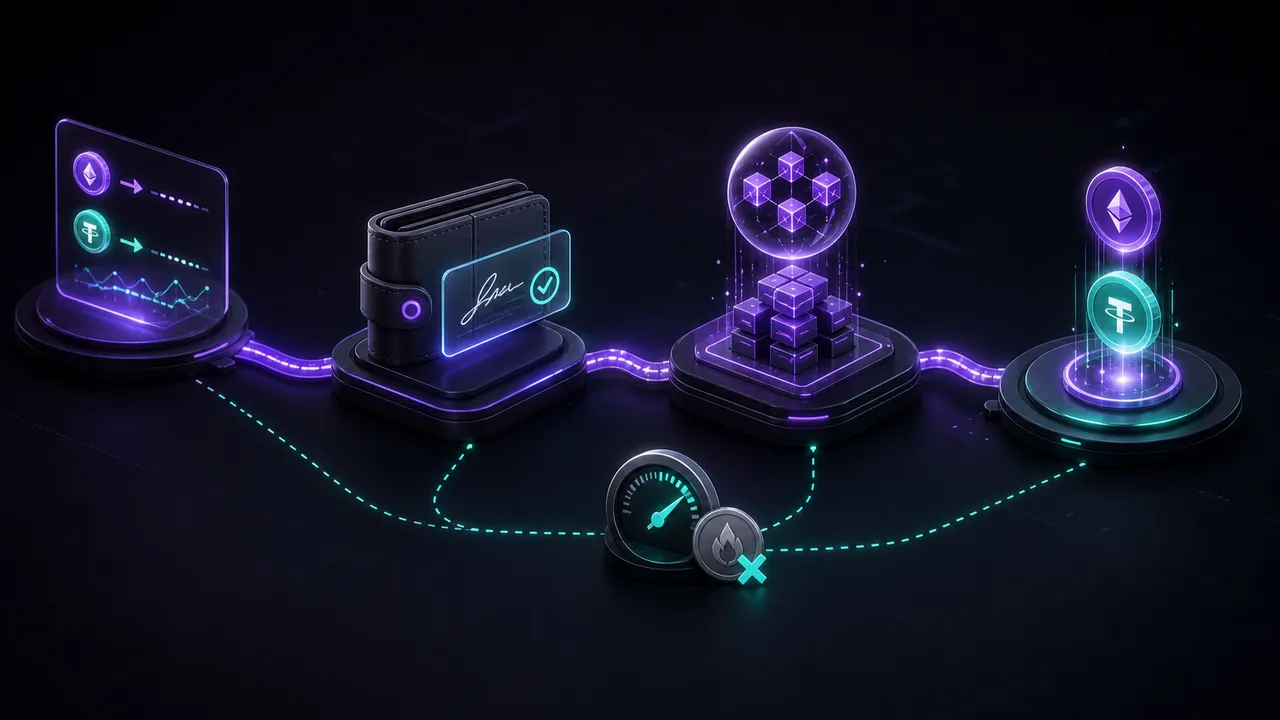 Guides
 Guides
How MindSwap Chooses the Best Route
Read more Guides
 Guides